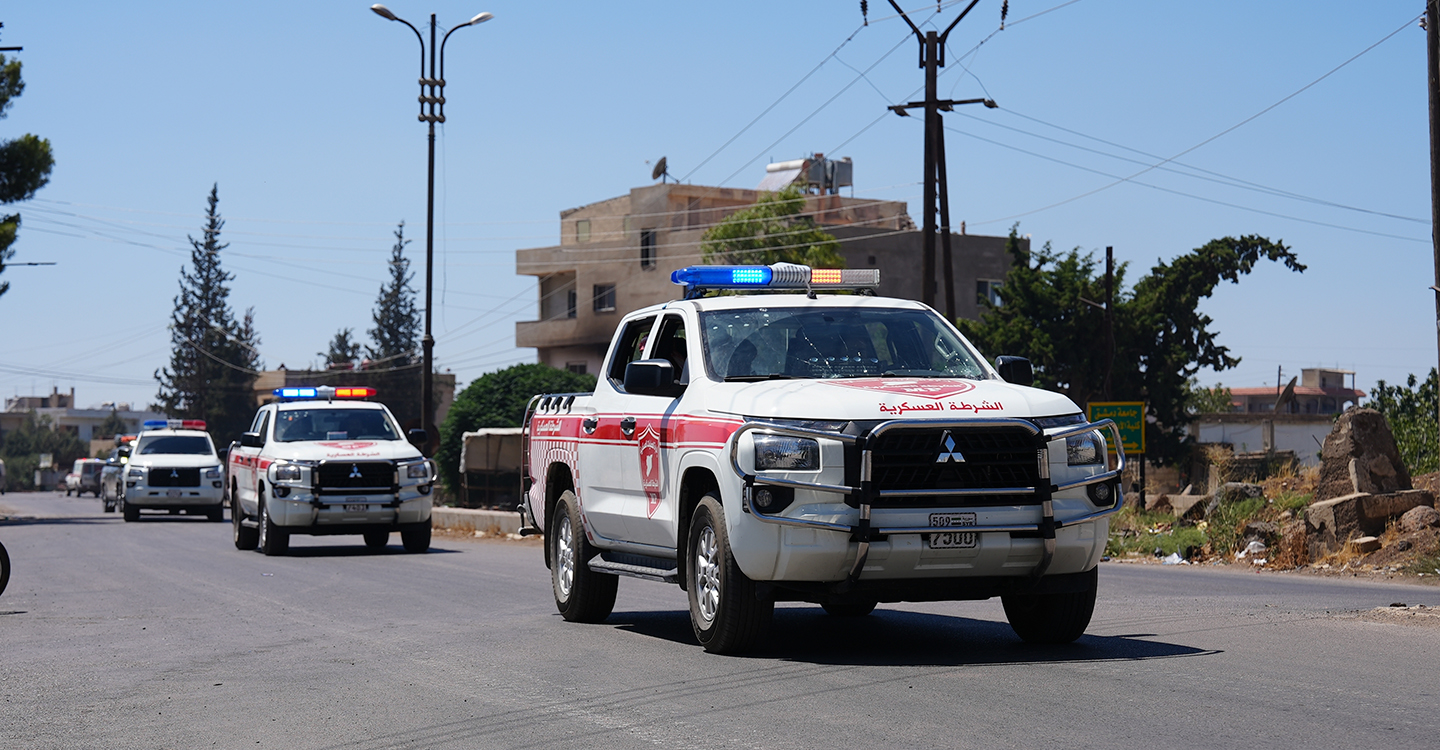
A US-brokered ceasefire on 17 July was thought to have brought an end to the most intense violence the southern Syrian province of Sweida has experienced in decades.
What began on 13 July as a localized dispute between Druze and Bedouin groups quickly escalated into a full-scale military confrontation between Druze fighters and transitional government-aligned forces. The fighting took a regional turn when Israel joined the fighting by bombing government forces in Sweida and the Ministry of Defence in Damascus. In just four days, the clashes claimed at least 516 lives and displaced many more, shaking the foundations of Syria’s already fragile transition.
With the ceasefire, the fighting subsided briefly, only for it to resume over the weekend – this time between Bedouin tribal forces and Druze groups – before ending on Sunday. The cessation of hostilities is, at best, tenuous. It should certainly not be mistaken for a return to normality.
What was once a simmering sectarian undercurrent has now erupted into open hostility. Hate speech, once confined to the margins of social media, has become mainstream and increasingly vocal, including by Syrian officials. This is exactly what makes the current ceasefire so fragile: it fails to account for how profoundly the political and social landscape has changed as a result of the fighting.
Halting the violence is a welcome step, but it does not amount to a resolution. Unless the deeper drivers of the conflict – including political exclusion and contested authority – are meaningfully addressed, the truce risks becoming little more than a brief pause before the next eruption.
Trigger point
Sweida’s violence began with the abduction of a Druze trader by individuals reportedly linked to Bedouin tribes in the region. In retaliation, a wave of reciprocal abductions broke out, eventually devolving into broader intercommunal violence. Such incidents are not unprecedented in southern Syria, where mistrust and unresolved grievances between the Druze and Bedouin tribes run deep. What set this episode apart was the decision of the country’s transitional authorities to intervene militarily.
Damascus presented the deployment of security forces as a step to restore order in coordination with some Druze actors. But many in Sweida, at least those who actively opposed the government deployment, viewed it as a power grab. This reaction stems from long-standing disputes between local Druze leaders and the transitional government – particularly over governance, security arrangements, and the identity of the future Syrian state.
Since the fall of the regime, Sweida’s notables have consistently advocated for decentralized governance and locally managed security structures tailored to the community’s needs. In contrast, Damascus remains committed to a rigid, top-down model. On broader questions of identity and political inclusion, Sweida’s calls for a secular and pluralistic system have largely been ignored.
These unresolved differences, compounded by repeated failures in negotiation, help explain why key Druze groups and leaders viewed Damascus’s intervention not as a stabilizing measure, but as an attempt to reassert central authority by force. Several episodes of sectarian violence targeting minorities, including attacks against Alawites in March and Druze in areas near Damascus in late April, have further amplified fears of this intervention.
The authorities’ failure to stop these attacks or hold perpetrators accountable has heightened fears in Sweida of facing similar atrocities.
Into the Fire
Against a backdrop of public fear and uncertainty, the transitional government’s intervention in Sweida triggered an armed response by armed Druze groups. Hostilities broke out between government forces and fighters loyal to Sheikh Hikmat Al Hijri, the most prominent Druze religious authority, on 14 July. Both sides traded blame: Damascus accused Al Hijri’s men of attacking its personnel, while Al Hijri accused the state of breaching prior commitments and committing serious abuses.
With a significant advantage in firepower, including heavy weaponry, government forces were able to impose near-total control over Sweida city by 15 July. At the same time, reports and videos began to surface about widespread abuses by government forces, including extrajudicial killings, degrading treatment of detainees, kidnappings, and looting. These violations triggered widespread public outrage and galvanized local resistance.
What began as a “security operation” quickly devolved into intense street battles, resulting in both military and civilian casualties. According to the Syrian Network for Human Rights, at least 558 people have been killed and more than 783 injured in Suwayda Governorate between 13 and 21 July. Perpetrators reportedly include fighters affiliated with the transitional government, as well as armed actors from the area – including both Druze and Bedouin fighters.
Efforts to mediate the crisis broke down multiple times, largely due to Al Hijri’s refusal to concede or compromise, driven by fears of widespread violations and concern that Damascus could impose its political visions on Sweida by force. The situation took a sharp turn when Israel launched air strikes on government forces in Sweida and key facilities in Damascus, including the Ministry of Defence, in response to the clashes in Sweida. Israel declared it would not permit the Syrian army to operate in the south and asserted its intention to defend the Druze community against potential aggression from Damascus.
Ceasefire, not peace
Fearing a broader regional escalation, the United States stepped in to contain the crisis, with support from regional actors including Turkey and Jordan. A ceasefire was eventually announced by interim President Ahmad Al Shara on the morning of 17 July, where he declared that government forces would withdraw from the province and transfer responsibility for maintaining security to local factions and Druze religious leaders. He described it as a necessary measure to prevent a deeper catastrophe and broader confrontation with Israel. While the details of the agreement remain sparse, open-source data suggests it largely reinstates the pre-conflict arrangement: Damascus withdraws its military units from the city and local forces retain de facto control over key areas of Sweida.
While the ceasefire halted fighting between government forces and Druze factions, it failed to stop the violence in the province. Reports emerged on 17 July of retaliatory attacks by Druze factions targeting Bedouin residents in Sweida, fueling public outrage among tribal communities. In response, fighters from various regions in Syria were dispatched to Sweida, turning the conflict into a wider intercommunal confrontation driven by revenge. The fighting continued until 21 July and only subsided after Damascus agreed to deploy security forces to the outskirts of Sweida to block external attacks.
Although the fighting in Sweida has paused, the ripple effects continue to fuel tensions nationwide. Inflammatory anti-Druze rhetoric seized on Israel’s strikes to depict the Druze community as collaborators or separatists, reinforcing sectarian narratives and fueling calls for collective punishment. The result has been a disturbing surge in incitement against the Druze minority, including calls to boycott Druze-owned businesses and expel Druze students from university dormitories. Meanwhile, many Druze – particularly those aligned with Al Hijri – have grown increasingly distrustful of the state and its institutions, further eroding the transitional government’s legitimacy.
What was once latent sectarian tension has now become overt and volatile, fueled by a surge in hate speech. The fighting has revealed the deep fault lines around competing visions for Syria and different narratives and perceptions not just between the government and other political forces, but also between large parts of the population. While such divergences are to be expected, the absence of mechanisms to air them out and address them – with the added complication of regional interventions – makes the situation explosive.
A mere return to the previous status quo is not just insufficient – it is dangerous. The events of the past week have profoundly altered Syria’s political and social landscape, leaving deep wounds and a toxic environment. In this context, a return to the previous arrangement is not a return to calm – it is a reversion to a simmering crisis that could explode at any moment. Only a genuinely inclusive and pluralistic political transition can address the underlying grievances, stem the violence, and set Syria on a path toward national healing.
Road map to peace
Sweida’s conflict is neither a simple security issue nor a local dispute. It reflects Syria’s deeper, long-standing fractures: contested authority, political exclusion, historical intercommunal tensions, declining trust in state institutions, and rising sectarian polarization.
The ceasefire may have stopped the gunfire – for now – but it has not resolved the underlying, multilayered conflict. Without concrete measures to address its root causes, this fragile calm is likely to collapse into renewed violence.
To break this cycle, the transitional government must adopt an inclusive, rights-based framework that tackles urgent grievances while laying the groundwork for national reconciliation and lasting stability. The following recommendations outline key short- and medium-term steps to move in that direction:
- ** Enforce the ceasefire and protect civilians**
Establish a credible and mutually agreed ceasefire monitoring committee that includes representatives from all parties, with the participation of mutually accepted external actors. This body should oversee the implementation of the ceasefire, verify reports of violations, and ensure rapid responses to protect civilians. In tandem, clear protocols should be adopted to prevent reprisals and ensure accountability for any renewed violence.
- ** Investigate abuses and ensure accountability**
Launch an independent and impartial investigation into all abuses committed during the recent clashes, regardless of the perpetrator. International and national human rights organizations should be invited to observe and support these efforts. Ending impunity through fair trials and transparent judicial proceedings will demonstrate a meaningful departure from past patterns of lawlessness and impunity.
- ** Tackle hate speech and sectarian incitement**
Swiftly counter the surge in sectarian rhetoric and incitement that accompanied the fighting. Public officials and community leaders must condemn hate speech and calls for revenge. Individuals spreading incitement should be held legally accountable, and targeted protection must be provided to at-risk communities. Public messaging must reinforce that sectarian violence has no place in the new Syria.
- ** Facilitate humanitarian access and restore basic services**
Ensure unrestricted humanitarian access to all affected areas. Collaborate with UN agencies and humanitarian actors to deliver critical supplies, including food, medical aid, fuel, and water. Restore essential public services and launch emergency relief programs to facilitate the safe return of displaced individuals.
- ** Reform the security sector**
Restructure Syria’s security architecture to rebuild trust across all communities. Retrain security forces to uphold human rights and prevent discriminatory or abusive practices. Deploy only well-disciplined units to sensitive areas, and establish clear mechanisms to track, investigate, and hold accountable individuals or units involved in misconduct.
- ** Advance reconciliation and strengthen social cohesion**
Establish an independent and empowered National Reconciliation Commission to replace the ineffective three-member committee formed in March to preserve civil peace. The existing body lacks the resources, authority, and expertise required to take on such a monumental task. Any new commission must be more than symbolic; it must be designed for impact, with a clear mandate, adequate tools, and broad legitimacy to carry out its mission effectively. It should collaborate with respected community leaders, religious figures, and civil society organizations to mend fractured social ties, address local grievances, and foster mutual understanding. The commission should also support grassroots initiatives that help communities resolve disputes quickly and peacefully.
- ** Launch a national dialogue to advance the transition**
Initiate a truly inclusive and transparent national dialogue that reflects Syria’s full diversity: ethnic, religious, geographic, and political. This Syrian-led process must offer a space to discuss core national issues such as decentralization, political representation, transitional justice, and the role of state institutions and security forces. The dialogue must produce tangible outcomes, including constitutional and institutional reforms, equal rights for all citizens, and guarantees of non-discrimination. Only through such a comprehensive process can Syria forge a lasting, inclusive political settlement and avoid further fragmentation.