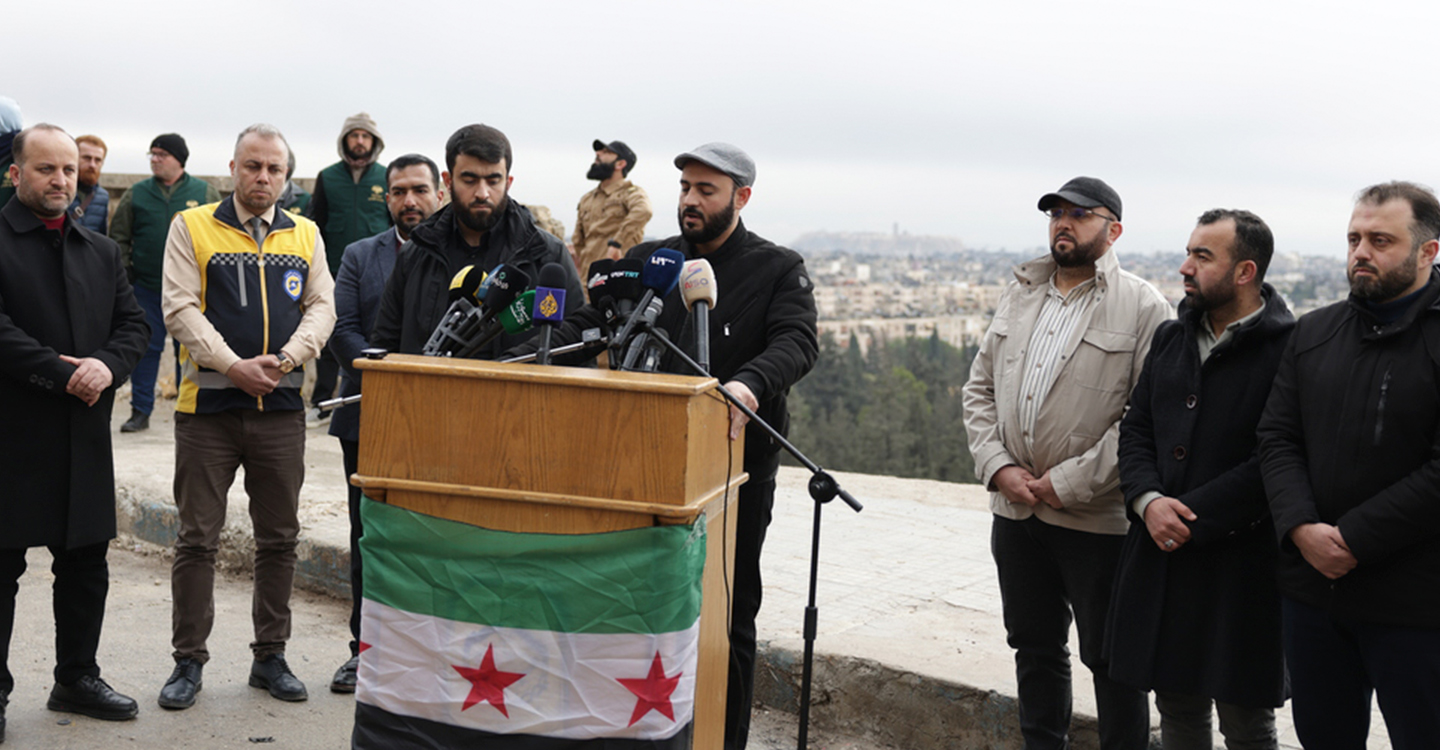
Clashes erupted on 6 January between Syrian government forces and Kurdish fighters in Aleppo, marking the most serious confrontation between the two sides since the fall of the Assad regime. What had long taken the form of episodic tension and tit-for-tat skirmishes has now tipped into a more decisive phase. It quickly became clear that Damascus was seeking to resolve its dispute with the de facto Kurdish authorities in Aleppo’s predominantly Kurdish neighborhoods through force rather than political engagement.
The military outcome was never in doubt. A small contingent of Kurdish fighters, confined to two fully encircled districts, stood little chance against government forces enjoying overwhelming advantages in manpower and firepower. That imbalance was swiftly exposed as government troops seized the contested neighborhoods within days, after allowing for the evacuation of several hundred fighters to northeastern Syria.
The more consequential question, therefore, is what the Aleppo escalation means for Syria’s broader political trajectory. Will the fighting derail the 10 March integration agreement signed by Syria’s interim president and the leadership of the Syrian Democratic Forces (SDF)? Or is it intended to jolt a stalled process back into motion through force?
That question has taken on added urgency following the Syrian army’s 13 January decision to designate the area between Deir Hafer and Maskanah in eastern Aleppo countryside as a closed military zone, raising the prospect of a new military operation. The move signals diminishing faith in negotiations by the Syrian government and a growing reliance on force as a means of breaking political deadlock. Rather than breathing life into the stalled 10 March integration process, the escalation in Aleppo risks marking the beginning of a new cycle of violence between government forces and the SDF, and raising the risks for Syria’s already tenuous transition.
Escalating Tensions in Aleppo
The two Kurdish-majority neighborhoods of Sheikh Maqsoud and Ashrafieh remained under SDF control even as the rest of Aleppo came under the authority of the transitional authorities following the ousting of the Assad regime. Despite longstanding tensions and occasional armed incidents, both sides appeared temporarily willing to accept the status quo.
That arrangement began to change after the 10 March agreement between Damascus and the SDF, under which both sides agreed in principle that SDF-controlled areas and forces would integrate into state institutions and launched talks on how to implement that framework.
Aleppo, however, presented a distinct case. The Kurdish-held neighborhoods constituted a small, fully encircled enclave, controlled by a limited force and geographically isolated from other SDF-held areas. As a result, a separate and more detailed agreement was negotiated on 1 April 2025, between Damascus and the Kurdish authorities in Aleppo to integrate Sheikh Maqsoud and Ashrafieh into the central state.
Under the terms of the deal, SDF-affiliated fighters were to withdraw from the neighborhoods, while Kurdish internal security forces, known as Asayish, would remain in place. Existing local councils were to continue administering the areas in coordination with Aleppo’s provincial institutions. The agreement was widely seen as a pragmatic compromise and a potential confidence-building measure.
Implementation, however, proved fragile. Mutual distrust and stalled progress in the broader 10 March negotiations slowed the integration of the two neighborhoods. As trust eroded and skirmishes became more frequent, the deal gradually lost much of its stabilizing effect. Clashes briefly erupted in October and later renewed in December 2025, but a local ceasefire was reached.
A Boiling Point
Unlike earlier clashes, the latest round of fighting, which erupted on 6 January, was not quickly contained. What began as another exchange of fire escalated rapidly into sustained urban combat, marking a clear departure from the episodic skirmishes that had characterized tensions in Aleppo for months. This time, the scale of mobilization—including the introduction of additional army units and heavy artillery—signaled an intent to decisively alter the balance on the ground rather than merely manage the confrontation.
The timing of the escalation was not accidental. It was closely linked to mounting frustration in Damascus over the stalled implementation of the 10 March integration agreement. That frustration intensified after the integration deadline embedded in the agreement passed at the end of December 2025 without meaningful progress. The negotiations stalled over disagreements on the pace, sequencing, and terms of integrating northeastern Syria—particularly regarding military and security arrangements, administrative structures, the distribution of authority, models of governance, and constitutional guarantees—leaving both sides deeply divided over how far and how fast integration should proceed.
Tensions sharpened further after the abrupt conclusion of the most recent round of negotiations between Damascus and the SDF, which began on 4 January and ended without a joint communiqué or any apparent breakthrough. The lack of progress reinforced a growing belief in Damascus that talks were being used to preserve the status quo rather than to move toward genuine integration, pushing frustrations to a boiling point.
While it remains unclear whether the fighting was directly triggered by the collapse of negotiations, the cumulative tension they produced appears to have altered Damascus’s calculations. Faced with what it perceived as a political impasse and rising security risks, the government opted to resolve the Aleppo dispute by force rather than continue a process it had come to view as unproductive.
From Deal to Confrontation
Once Damascus’s military operation to seize the neighborhoods began, the balance of power quickly tilted in the government’s favor. Kurdish fighters—limited in number, confined to two encircled districts, and badly outgunned—struggled to hold their positions. Syrian government forces moved swiftly, capturing Ashrafieh with relative ease. The advance encountered limited resistance, reportedly aided by a deal the government brokered with elements of the Baqara tribe that had been fighting alongside Kurdish units.
The fighting then expanded into Sheikh Maqsoud, where clashes were more intense. Despite initially refusing to surrender, Kurdish-led fighters eventually agreed on 10 January to a withdrawal arrangement that allowed them to relocate to northeastern Syria. The deal brought the fighting to an end and placed the entire city of Aleppo under full government control.
The operation also reflected a significant shift in tactics. Rather than relying on indiscriminate or overwhelming firepower, government forces conducted targeted strikes against designated military positions, advancing in stages and announcing ceasefires along the way. Authorities publicly identified areas to be targeted and urged civilians to evacuate in advance—an apparent effort to limit casualties. This approach contrasted sharply with operations last year along the coast and in Sweida, which were widely criticized for extensive civilian harm and systematic violations.
Despite these measures, the humanitarian impact was severe. At least 23 people were killed according to UN OCHA, and around 150,000 residents were displaced. Entire neighborhoods were left without reliable access to food, water, or medical care as families fled under fire to precarious shelters elsewhere in Aleppo or to camps outside the city. For many civilians, the trauma of repeated displacement compounded longstanding vulnerabilities, underscoring how even limited urban combat exacts a heavy toll on noncombatants.
Negotiations at Gunpoint
Conversations with government officials suggest that the Aleppo operation was intended to convey a clear political message. The rapid capture of most Kurdish-held neighborhoods, they argue, was meant to signal that Damascus’s patience had run out and that it was no longer willing to tolerate half-measures or prolonged delays.
From this perspective, the use of force was designed to jolt stalled negotiations back into motion and compel Kurdish leaders toward swift implementation of the 10 March integration agreement. The fighting in Aleppo, in this reading, was less a strategic turning point than a warning shot—intended to pressure the SDF into compliance.
These sources also contend that the government’s more disciplined operational approach served a dual purpose. Beyond reassuring external actors—particularly Western governments wary of civilian casualties—it was intended to demonstrate Damascus’s capacity to reintegrate contested areas into a unified state through force, signaling that military options remain firmly on the table.
Seen through this lens, the Aleppo episode was not simply about seizing territory, but about reshaping incentives. By altering the balance of power on the ground, Damascus hopes to convince Kurdish leaders that delaying negotiations is no longer viable, and that continued resistance risks a military outcome that would forfeit many of the political and administrative concessions embedded in the March agreement.
A Risky Bet
Conversations with Kurdish officials reveal that they see the Aleppo escalation through a very different lens. They argue that the clashes were initiated by Damascus as part of a deliberate decision to retake the neighborhoods by force—a move they say has inflicted lasting political damage. Rather than advancing compromise, they contend, the use of military pressure has deepened mistrust and reinforced a belief among Kurdish leaders that Damascus ultimately favors coercion over consensus.
Senior figures within the SDF made public statements that confirm this private messaging. For instance, Sipan Hemo, a senior SDF commander, has warned that the Aleppo operation risks pushing relations with Damascus onto a more confrontational path. Military pressure, he argues, is unlikely to produce durable integration and will instead deepen resistance and insecurity. From this perspective, the fighting in Aleppo was not an isolated episode, but a troubling precedent—one that raises fears the government may resort to similar tactics elsewhere if negotiations stall.
Foza Yusuf, a leading Kurdish political figure, has gone further, accusing Damascus of having planned the Aleppo operation months in advance despite continued political engagement. Her accusation underscores the depth of mistrust now shaping relations. While stopping short of declaring the 10 March agreement dead, she has described it as effectively “in a coma.”
Seen through this lens, the Aleppo operation has set integration talks back rather than moved them forward. By shifting the balance of power through force, Damascus appears to have narrowed the space for compromise instead of expanding it. Rather than encouraging flexibility, the escalation is likely to harden Kurdish positions in future negotiations, as leaders seek to avoid the political costs of appearing to negotiate from a position of weakness.
Signs of Escalation
Meanwhile, signs of rising tension and reports of increased mobilization by both sides in northeastern Syria suggest that further escalation is likely. Shortly after the fighting subsided in Aleppo, tensions shifted to other SDF-held areas, with limited skirmishes reported around Raqqa and near the Tishreen Dam in the Manbij area.
More alarmingly, on 13 January, the Syrian army announced that it had designated the area between Deir Hafer and Maskanah in eastern Aleppo countryside as a closed military zone. The map published with the statement showed a broad area extending from the outskirts of Deir Hafer through Qawas and Babiri to Maskanah on the western shore of the Assad Lake.
According to the statement, the area was being used as a launch point for suicide drones that had recently targeted Aleppo, prompting what the army described as immediate military measures.
The army urged civilians living near the area to stay away from SDF positions for their own safety and called on all armed groups within the designated zone to withdraw immediately to the east of the Euphrates River.
It warned that it would do “whatever is necessary” to prevent the area from being used as a platform for attacks—signaling the possibility of further military operations. The escalation comes shortly after authorities dispatched reinforcements to the area in response to what they described as suspicious SDF mobilization—claims the SDF has denied.
These are the same dynamics that preceded the fighting in Aleppo, underscoring not only the seriousness of the current escalation but also the risk that the Aleppo model is now being replicated elsewhere.
A Domino Effect
The Syrian authorities’ recent heightened emphasis on decisive military action to seize areas used to launch attacks suggests a recalibration of strategy. Where Damascus once prioritized political engagement to contain such threats, it now appears increasingly willing to capture territory outright as a means of enforcement. This growing reliance on force—rather than dialogue—to resolve disputes with the SDF marks a troubling shift in the government’s approach to the political and security challenges it faces during the transition.
The implications of this shift extend far beyond Aleppo. It lowers the threshold for escalation by establishing a precedent in which military action can be justified against any area from which attacks are reported. The absence of independent mechanisms to verify competing claims or assign responsibility for such attacks further compounds the risk. More importantly, there is no clear framework for addressing violations, leaving few—if any— viable off-ramps for de-escalation.
The United States, along with other Western governments, has repeatedly emphasized its preference for dialogue over force in managing disputes between the SDF and Damascus. Yet that position failed to prevent, or stop, the fighting in Aleppo and may face similar limitations should tensions boil over around Deir Hafer. Turkey’s stance—appearing strongly supportive of Damascus’s strategic shift—may help explain the relatively muted and limited pushback from Washington.
No Winners
The apparent strategic shift in how Damascus manages security challenges, particularly those linked to the SDF, significantly heightens the risks posed by future skirmishes. The danger is no longer limited to the possibility that isolated incidents might spiral through miscalculation. Increasingly, the mere occurrence of such incidents may itself be used to justify decisive military action.
Unlike Aleppo, however, a conflict in northeastern Syria would neither be swift nor contained. The region is far larger and more complex, and SDF forces there are better trained and equipped, with thousands of ideologically committed fighters. Tribal actors have also repeatedly expressed a strong desire to join any confrontation with the SDF, raising the risk of counter-mobilization, intercommunal violence, and large-scale abuses.
In such a scenario, the central question would no longer be how easily Damascus could capture territory in Deir Hafer or elsewhere in the northeast, but what lasting damage further escalations would inflict on Syria’s already fragile transition and on relations among its ethnic and religious communities.
As Sweida has already demonstrated, such confrontations rarely produce resolution. More often, they entrench deadlock—leaving everyone worse off, including the side that prevails on the battlefield.