Abstract
Southern Syria—comprising Quneitra, Daraa, and Sweida Governorates—has long been a volatile border region. The collapse of the Assad regime on 8 December 2024 initially inspired optimism and hopes for stability. Yet the region quickly entered a period of profound political and security transformation. Viewed in a broader historical context, many of the security challenges observed today in the southern region are not entirely new. They have deep roots in the wartime period and in the coercive and manipulative policies implemented by the Assad regime after its return to the region in July 2018, albeit in forms and patterns that have been reshaped, reconfigured, and reproduced after its collapse. Foreign intervention, too, is far from recent: regional and international actors have long influenced and exacerbated instability in the south.
Situated within this historical and geopolitical context and drawing on a mixed-methods approach—including in-depth interviews with a diverse range of local actors and two original datasets documenting armed groups and violent incidents—this research paper provides a nuanced, context-specific analysis of the complex security dynamics in Daraa, Quneitra, and Sweida Governorates. The paper pursues three main objectives. First, it offers a historical overview of the security environment under the Assad regime, from its return to the region in 2018 until its collapse in December 2024. Second, it examines the current security challenges across the three governorates during Syria’s political transition, with particular focus on the modalities and impacts of Israeli intervention, the underlying causes and patterns of violence, and the conditions facilitating persistent drug trafficking into Jordan. Third, this paper probes the incentives, constraints, and strategic preferences of relevant domestic, regional, and international actors in relation to two externally driven approaches to stabilization: a potential Russian redeployment to the south and the prospects for a U.S.-mediated Syrian-Israeli security arrangement.
Findings reveal that domestic and external factors shape security outcomes as much as state authority in Daraa, Quneitra, and Sweida. Israeli intervention reshapes the security environment, constrains state authority, and empowers local actors. Within this fragmented landscape, the resurgence of violence reflects an interplay of wartime legacies, unresolved rivalries, resilient armed networks, and widespread proliferation of weapons. State efforts to dismantle armed networks and assert control face significant challenges; in some instances, interventions are modest, generate grievances, or provoke local resistance. At the same time, militarized drug-trafficking networks exploit weak state presence, drug stockpiles, and adaptive smuggling methods to maintain operations across the border into Jordan. Foreign intervention continues to be a central factor, simultaneously generating instability while shaping any proposed approach to stabilization. U.S.-backed Israeli-Syrian talks and potential Russian redeployment each offer opportunities to reduce volatility, but both create dependencies on external mediation and influence the exercise of state authority. These overlapping dynamics produce a deeply unstable environment, where each factor reinforces the others, and persistent challenges for stabilization endure throughout the transitional period.
Introduction
Southern Syria—corresponding to Quneitra, Daraa, and Sweida Governorates—has long been a volatile border region. Following the onset of the Syrian revolution in March 2011 and its subsequent militarization, the Assad regime sustained significant territorial losses in Daraa and Quneitra, where armed opposition groups captured large swathes of the two regions. In Sweida, the predominantly Druze population maintained a largely neutral stance that constrained the regime’s ability to reassert full control and allowed a degree of autonomy to emerge, albeit occasionally disrupted by periods of heightened tensions with the regime. The return of the regime in July 2018, backed by Russia and Iran, ushered in a new phase in which the three governorates increasingly converged around a common set of features: tenuous regime control, foreign interventions—primarily by Iran, Russia, and Israel—, widespread availability of weapons and proliferation of armed groups, sporadic outbreaks of violence, expansion of criminal activities, and intermittent patterns of anti-regime civil resistance movements. In many respects, the border region reflected both a symptom and a microcosm of the country’s broader fragmentation, with chaos, violence, and uncertainty defining daily life. By the final years of Assad’s rule, southern Syria featured a patchwork of contested spaces, where coercion, resistance, negotiation, and semi-autonomous spheres coexisted.
When Ha’yat Tahrir al-Sham (HTS) launched a decisive military offensive against the regime in late November 2024, many local armed groups across Daraa, Sweida, and Quneitra came together under the umbrella of the Southern Operations Room (SOR) and dismantled what remained of regime control in the region. The subsequent collapse of the Assad regime on 8 December 2024 marked a new chapter for southern Syria. While the end of authoritarian rule inspired hopes for stability, southern Syria soon confronted a range of political and security challenges.
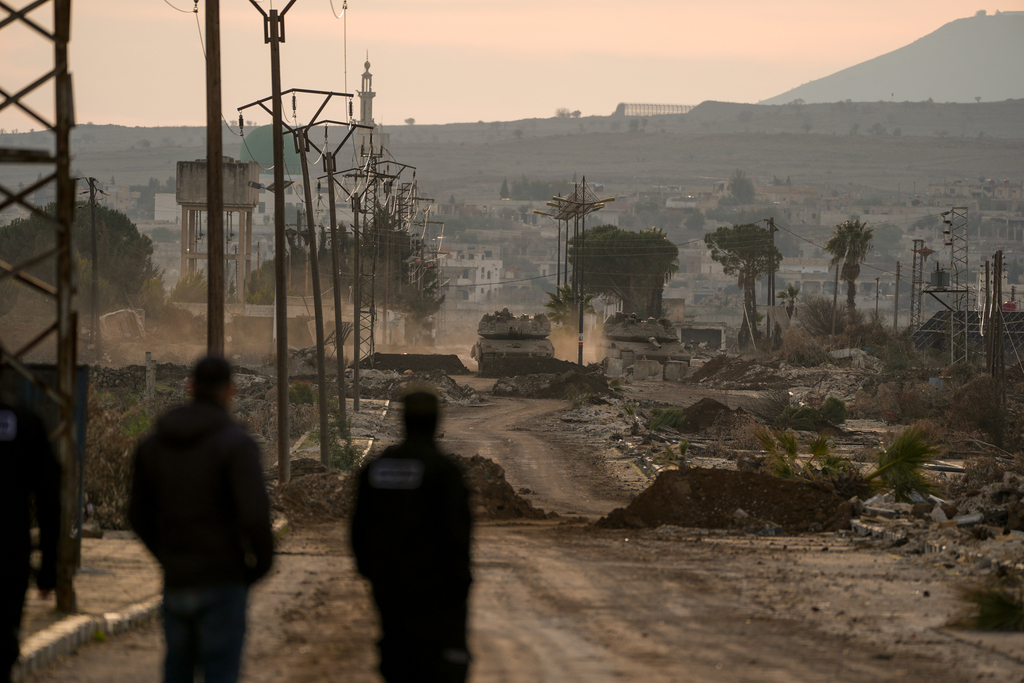
In Quneitra, Israel’s sustained military presence at multiple strategic positions, combined with regular ground incursions and patrols, produces uneven state control. In Daraa, uncollected weapons and resilient armed networks continue to fuel episodic violence, while Israel’s limited forward presence and the threat of targeted air strikes to enforce demilitarization leave state authority neither fully established nor uncontested. In Sweida, attempts by the state to consolidate control triggered outright resistance by Druze armed groups and a calibrated deterrent intervention by Israel. The ensuing July 2025 clashes—marked by lethal confrontations, extrajudicial killings, and civilian displacement—left the state with only limited effective authority across much of the governorate. The weak state control in parts of the south enabled decentralized and militarized criminal networks, which briefly went dormant following the fall of the former regime, to resume smuggling drugs into Jordan. As such, the southern landscape demonstrates the fragmented and volatile environment that the new authorities must now contend with—one that has historical roots and requires nuanced, careful, context-specific analysis to understand and navigate.
When placed in a broader, historical context, many of the security challenges observed today in the south are not nascent per se, but have deep roots in the wartime period and in the coercive and manipulative policies adopted by the Assad regime after its return to the region, albeit in forms and patterns that have been reshaped and reconfigured since its collapse. Foreign intervention is likewise far from a recent phenomenon. Regional and international actors have long influenced and, at times, exacerbated instability in the south. This generates a structural dilemma insofar as external involvement—despite its destabilizing potential—continues to figure centrally in any proposed approach to stabilization in post-Assad southern Syria.
Situated within this historical and geopolitical context, this research paper illustrates the security landscape that prevailed in the region from the Assad regime’s return in 2018 through its eventual collapse in December 2024. Accounting for temporal and spatial variations across Quneitra, Daraa, and Sweida Governorates, the paper then seeks to examine current security challenges, with a particular focus on the modalities and impacts of Israeli intervention, the underlying causes and patterns of observed violence, and the conditions enabling persistent drug trafficking. The paradox of foreign intervention in the south constitutes another central dimension of the analysis. The research paper aims to probe the incentives, constraints, and strategic preferences of relevant domestic, regional, and international actors, particularly in relation to a potential Russian redeployment to the south and the prospects for a U.S.-mediated Syrian-Israeli security arrangement.
This research paper draws on extensive prior research conducted by the author on the micro- and regional-level security dynamics of wartime and postwar southern Syria. It employs a mixed-methods approach, integrating qualitative and quantitative evidence. The qualitative analysis draws on in-depth interviews conducted with a diverse range of local actors since 2018—including civilians, activists, and leaders of armed groups. It also draws on prior research by specialists on the region, as well as coverage from prominent Syrian, regional, and international media outlets. The quantitative analysis is based on two original datasets compiled by the author: the first documents the structure, manpower, affiliations, and areas of operation of over 200 armed groups in Daraa Governorate between 2018 and 2024; the second dataset systematically tracks over 5,000 violent incidents in Daraa (from July 2018) and Quneitra (from December 2024), capturing the actors involved, when identifiable, as well as the spatio-temporal distribution, intensity, scale, and fatalities and injuries associated with each violent incident.
Findings reveal that domestic and external factors shape security outcomes as much as state authority in Daraa, Quneitra, and Sweida. Israeli intervention influences the security environment, constrains state authority, and empowers local actors. Within this fragmented landscape, the resurgence of violence reflects an interplay of wartime legacies, unresolved rivalries, resilient armed networks, and widespread proliferation of weapons. State efforts to dismantle armed networks and assert control face significant challenges; in some instances, interventions are modest, generate grievances, or provoke local resistance. At the same time, militarized drug-trafficking networks exploit weak state presence, drug stockpiles, and adaptive smuggling methods to maintain operations across the border into Jordan. Foreign intervention continues to be a central factor, simultaneously generating instability while shaping any proposed approach to stabilization. U.S.-backed Israeli-Syrian talks and potential Russian redeployment each offer opportunities to reduce volatility, but both create dependencies on external actors and influence the exercise of state authority. These overlapping dynamics produce a deeply unstable environment, where each factor reinforces the others, and persistent challenges for stabilization endure throughout the transitional period.
The paper is structured as follows. The first section provides a historical overview of southern Syria’s security landscape from 2018 to 2024. The second examines the security challenges that characterize the region since December 2024. The third analyzes the paradox of foreign intervention, focusing on U.S.-backed Syrian-Israeli security talks and the potential Russian redeployment. The conclusion synthesizes the findings and evaluates prospects for stabilization.