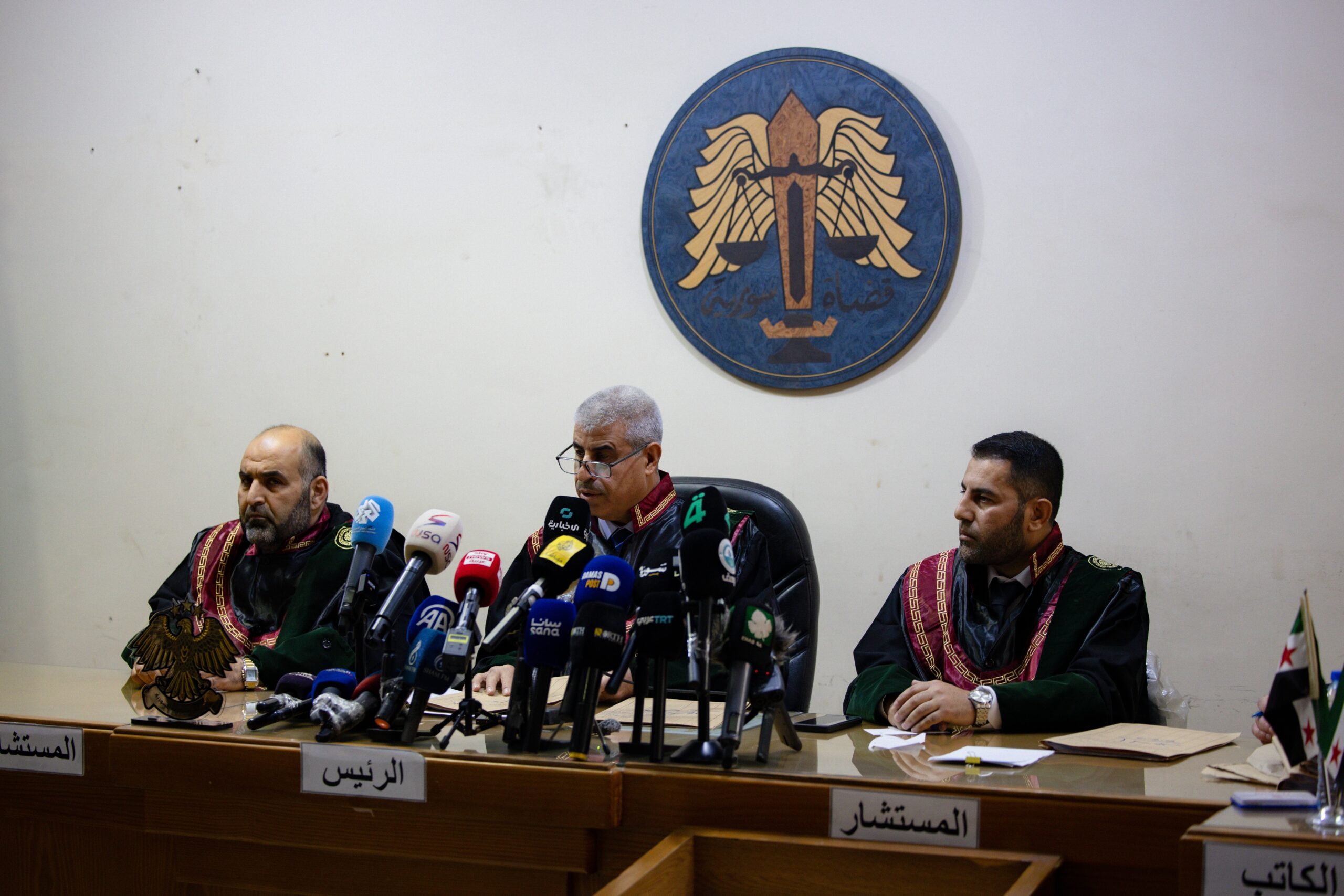
On 18 December, the special court examining the crimes committed in Syria’s coastal region in March 2025 will convene its second session. Its first session was held as a “public hearing” on 18 November 2025 at the Palace of Justice in Aleppo. Fourteen individuals were brought before the court: seven accused of committing crimes against members of General Security (the internal security force) and the Ministry of Defense, and seven accused of committing crimes against civilians, according to Syrian state media. The head of the military court, Alaa Al-Din Latif, also noted that additional detainees remain under investigation and that their cases will be transferred to the Criminal Court to complete judicial procedures.
In its report on the coastal events, the UN’s Independent International Commission of Inquiry on the Syrian Arab Republic stressed the need for robust reforms to Syria’s judicial system, noting that the judiciary inherited from the Assad regime requires major transformation before it can provide institutions that uphold the rule of law and protect all Syrians equally.
Despite shortcomings in national legislation and structural problems in the judicial system, the “Trial for Coastal Violations” constitutes an important opportunity to build and strengthen capacities in several vital areas—legal and judicial reform, the role of civil society (particularly in trial monitoring), and the media’s role in public oversight.
The prosecution of the grave crimes committed in Syria’s coastal region carries historic and legal significance. It is the first case of its kind in decades, marking a departure from a past characterized by secretive judicial processes and a lack of accountability for members of state security services. It also represents a key test of whether authorities can build local and international confidence in their ability to hold perpetrators accountable and deliver justice to victims on all sides.
This article seeks to highlight the aspects that must be improved to ensure due process within Syria’s current judicial landscape, and to enable this trial to break the longstanding cycle of impunity in the country. It does not represent a comprehensive assessment of the court’s adherence to fair trial standards, as the proceedings are still ongoing.
Background on the Syrian Coastal Crimes
On 6 March 2025, armed groups loyal to the former Bashar al-Assad regime attacked forces belonging to the interim government’s General Security and Ministry of Defense, killing and injuring dozens of their members. The attackers also issued a statement announcing the creation of the “Military Council for the Liberation of Syria,” claiming that the council aimed to “liberate all Syrian territory from all occupying and terrorist forces.” The Interim Government dispatched reinforcements to the affected areas, but they fell into ambushes and suffered additional casualties. Armed civilians from Sunni and Alawite communities also clashed in the city of Jableh.
In response, government forces—including General Security and Ministry of Defense units—launched a security operation and sweep across the region. They were joined by armed groups and individuals, many of them arriving from other parts of Syria after calls for general mobilization. Pro-government armed actors targeted Alawite civilians in retaliatory attacks, in some cases asking individuals whether they were Alawite or had served in the former regime’s armed forces before threatening or killing them. The forces also abducted and executed men from certain Alawite families. They also killed women and children during certain house raids.
The violence included killings, torture, mutilation of bodies, the desecration of the dead, widespread looting, and the burning of homes. Tens of thousands of civilians were displaced. These violations were committed by Interim Government forces, civilians acting alongside them, and fighters loyal to the former Assad regime (the so-called “fulul” or “remnants”).
On 9 March, interim Syrian president Ahmed Al-Sharaa announced the creation of an “Independent National Committee to Investigate and Ascertain the Facts of the Syrian Coastal Events.” The committee investigated the incidents but did not publish its full report. On 22 July 2025, it released its findings and recommendations, stating that 238 military and security personnel and 1,426 civilians had been killed—including 90 women—and that 563 suspects had been referred to the judiciary. The special court for the coastal events began operating on 18 November.
Available Information on the Court
Official sources do not offer a clear picture of the court’s legal nature. At the opening of the first session, the presiding judge declared:
“The court is national, neutral, and independent… The applicable law is the Military Penal Code No. 61 of [year], the General Syrian Penal Code No. 148 of 1949, and the applicable procedural law is the Code of Criminal Procedure No. 112 of 1950.” Alaa Al-Din Latif, head of the Military Court in Aleppo, added: “After the investigations concluded, the files were transferred to the Military Criminal Court and the violations were tried in accordance with due process.”
The panel consists of three judges: presiding judge Zakaria Abdul Ghani Bakkar (head of the Fifth Criminal Court in Aleppo), and advisors Hussein Al-Sharif and Ahmad Mukhlis Al-Mahmoud. Judge Bakkar stated that the court was created “based on the reports of the international committee and the national committee on the coastal events,” yet the legal text establishing the court and its justification were not published.
Under Syrian national law, military courts have jurisdiction over military crimes and offenses committed on military sites. They may also try civilians if they are perpetrators of such crimes or accomplices, provided one of the co-defendants falls within the jurisdiction of the military judiciary (e.g., a military defendant), according to Military Penal Code No. 61 of 1950.
Article 44 of the Syrian Constitutional Declaration stipulates that “courts are established, and their jurisdictions defined, by law.” The absence of an official decree establishing the court and clarifying its legal basis raises serious questions about its legitimacy and about the independence of its judges—particularly given the appointment of judges by the Ministry of Defense.
Initial Observations
1. “Public” Hearings
Authorities allowed journalists and observers to attend the session, heavily emphasizing its “public” nature. The presiding judge described the first hearing as representing “complete and absolute transparency.” According to the Ministry of Justice, more than 150 domestic and international media outlets attended, along with some families of victims and defendants.
However, the trial date was announced only one day in advance—insufficient time for media or observers to prepare professional coverage. It is also unclear whether families of victims and defendants were notified in time to travel to Aleppo, given that most live in the coastal region far from the court.
Under international standards, the right to a public trial is not fulfilled merely by opening courtroom doors. According to the UN Human Rights Committee’s General Comment No. 32 on Article 14 of the ICCPR, courts must proactively inform the public by providing:
- comprehensive information on hearing dates and locations
- clear details about the responsible court
- logistical arrangements enabling public attendance, including relocation of hearings where necessary
Moreover, withholding the results of the original investigation conducted by the national committee undermines transparency: observers are unable to assess the trial’s factual and legal foundations.
2. Legal Framework of the Court
There is ambiguity regarding whether the court is extraordinary or a military court exercising personal jurisdiction over civilians. The Syrian Constitutional Declaration prohibits the creation of extraordinary courts but allows specialized courts that operate in accordance with fair trial standards.
International law places strict limits on the trial of civilians before military courts: such trials must be demonstrably necessary and objectively justified. The court must therefore clearly articulate its legal framework and demonstrate its compliance with both international standards and the Syrian Constitutional Declaration.
3. Classification of Crimes Under International Law
Charges in the first session included premeditated murder, “sectarian strife,” conspiracy, looting, destruction, incitement of civil and sectarian war, leading or joining an armed gang, and attacking public forces to commit major crimes. However, the UN Commission of Inquiry stated that the violations “may amount to war crimes” and outlined Syria’s obligations under international law.
Relying solely on national law, without incorporating relevant international crimes (which Syria is bound to apply under the Constitutional Declaration), represents a missed opportunity for the judiciary to take a historic step toward victim-centered justice and alignment with international legal norms.
4. Allegations of Torture
One defendant—identified by the court as a “rebel,” meaning loyal to the former regime—alleged torture or threats of torture during interrogation. The judge responded by asserting that the military investigating judge does not practice torture; the defendant replied that the judge has the authority to return detainees to the investigators that tortured him. The court nonetheless ordered the defendant returned to the same military investigative judge.
Allegations of torture must be treated with utmost seriousness. Under the Convention Against Torture, Syria is obligated to:
- immediately open an impartial investigation
- exclude any evidence obtained by torture
- protect complainants and witnesses from reprisals
How the court handles this claim, and whether it holds perpetrators accountable, will be a critical indicator of its credibility.
5. Monitoring and Media
Authorities allowed broad media presence, but Syrian outlets did not broadcast the opening of the session. Coverage overall was selective, intermittent, at times technically unclear, and often resembled dramatized clips rather than professional court reporting. Some coverage was accompanied by partisan or inflammatory commentary.
Media and civil society have a vital role to play in monitoring trials and expanding transparency beyond the courtroom. But effective monitoring requires access to sufficient information to assess compliance with national and international standards. If done well, trial monitoring:
- Ensures that trials are conducted in accordance with the fundamental principles of a fair trial.
- Increases public confidence in the judicial system by shedding light on procedures.
- Identifies and addresses any violations or weaknesses in the legal system or its procedures.
- Ensures that the rights of all parties are respected, especially the right to defense, the right to be heard, and the transparent and respectful treatment of victims.
- Provides necessary recommendations to legislators, judges, and lawyers to improve legal practice.
Ultimately, media outlets play a greater role than the court itself in conveying information to the public, which requires them to exercise accuracy, integrity, and objectivity in reporting and analyzing news, and to ensure the selection of qualified guests to avoid misleading public opinion.
These trials represent a pivotal opportunity to build expertise in specialized legal coverage, which will form a significant part of the Syrian landscape in the coming years. Preparing Syrian journalism for this type of reporting requires training media personnel—both correspondents and editors—on understanding precise legal terminology and trial procedures, as well as distinguishing between types of crimes and evidence. Establishing specialized legal journalism is essential for transitioning from general news coverage to expertise-based coverage of court proceedings.
What to Watch for in Upcoming Sessions
The coastal crimes trials represent a promising beginning toward transparency and accountability. But achieving a fully fair and public trial requires close monitoring of the following:
- Legal basis and jurisdiction: publication of the court’s founding decision, its legal rationale, and how it reconciles military jurisdiction with the trial of civilians and serious crimes; assessment of judicial independence.
- Torture allegations: whether the judiciary initiates an independent investigation and excludes coerced evidence.
- Rights of parties: ensuring families’ access to counsel and ensuring defense lawyers can perform their duties effectively.
The continuation and success of this judicial process offer a historic opportunity for Syria to break with its past and establish a model for transitional justice and accountability. Ultimately, the significance of the Coastal Crimes Court will not be measured by the number of verdicts issued, but by its ability to build trust in an independent, impartial judiciary that protects the rights of all parties.