As hopes dim for a political settlement between the Democratic Autonomous Administration of North and East Syria (DAANES) and the transitional government in Damascus, fears are mounting that a new wave of violence could erupt. The DAANES’s conference in Hasakah on 8 August, which was attended by representatives of various ethnic and religious communities from the northeast with the aim of presenting a unified negotiating stance with the government, was met with sharp condemnation from Damascus. In a swift response, the Syrian government withdrew from the Paris-hosted talks that were meant to take place this month, accusing the conference of breaching previous agreements and threatening the country’s territorial integrity.
The warning signs of possible conflict are clear and increasingly alarming. With diplomacy stalled, leaders from various tribes, including Al-Nasser, Al-Saab, Al-Boubna, and Al-Boujaber, are shifting from rhetoric to mobilization, openly calling for armed confrontation with the Syrian Democratic Forces (SDF). Even more concerning is the continued silence from Damascus. The pressing question now is whether tribal forces will attempt to replicate their recent military campaign in Sweida, this time targeting the SDF in northeast Syria? And if they do, will Damascus remain on the sidelines, at least until it can leverage the chaos to reassert control over Arab-majority areas in the northeast that it has long sought to reclaim? While such a manoeuver might serve short-term interests, it would come at a dangerous cost: deepening ethnic divisions, derailing any path toward national reconciliation, and pushing Syria further away from a durable and inclusive peace.
Fault Lines Widen
Tensions between Damascus and the DAANES have long simmered beneath the surface, despite the 10 March agreement that outlined a framework for integrating civilian and military institutions in the northeast into the Syrian state. Stalled negotiations since then have heightened the strain. But the recent Hasakah conference has deepened the divide, raising new and serious concerns.
The 8 August conference, titled “Unity of Position for the Components of Northeast Syria,” was organized by the DAANES to establish a unified stance among different ethnic and religious communities, including tribal leaders aligned with the SDF, ahead of renewed talks with Damascus. However, the participation of prominent figures opposed to Damascus from outside the region, such as Druze spiritual leader Sheikh Hikmat al-Hijri from Sweida and the Supreme Alawite Islamic Council Ghazal Ghazal, was seen by the Syrian government as a direct provocation. The government interpreted their presence as an attempt to forge cross-regional alliances and as a veiled push for decentralization, or even secession.
In swift retaliation, Damascus pulled out of the planned negotiations scheduled to take place in Paris this month, denouncing the Hasakah conference as a breach of the 10 March agreement and a serious threat to Syria’s territorial integrity and national unity.
Tribal War Drums
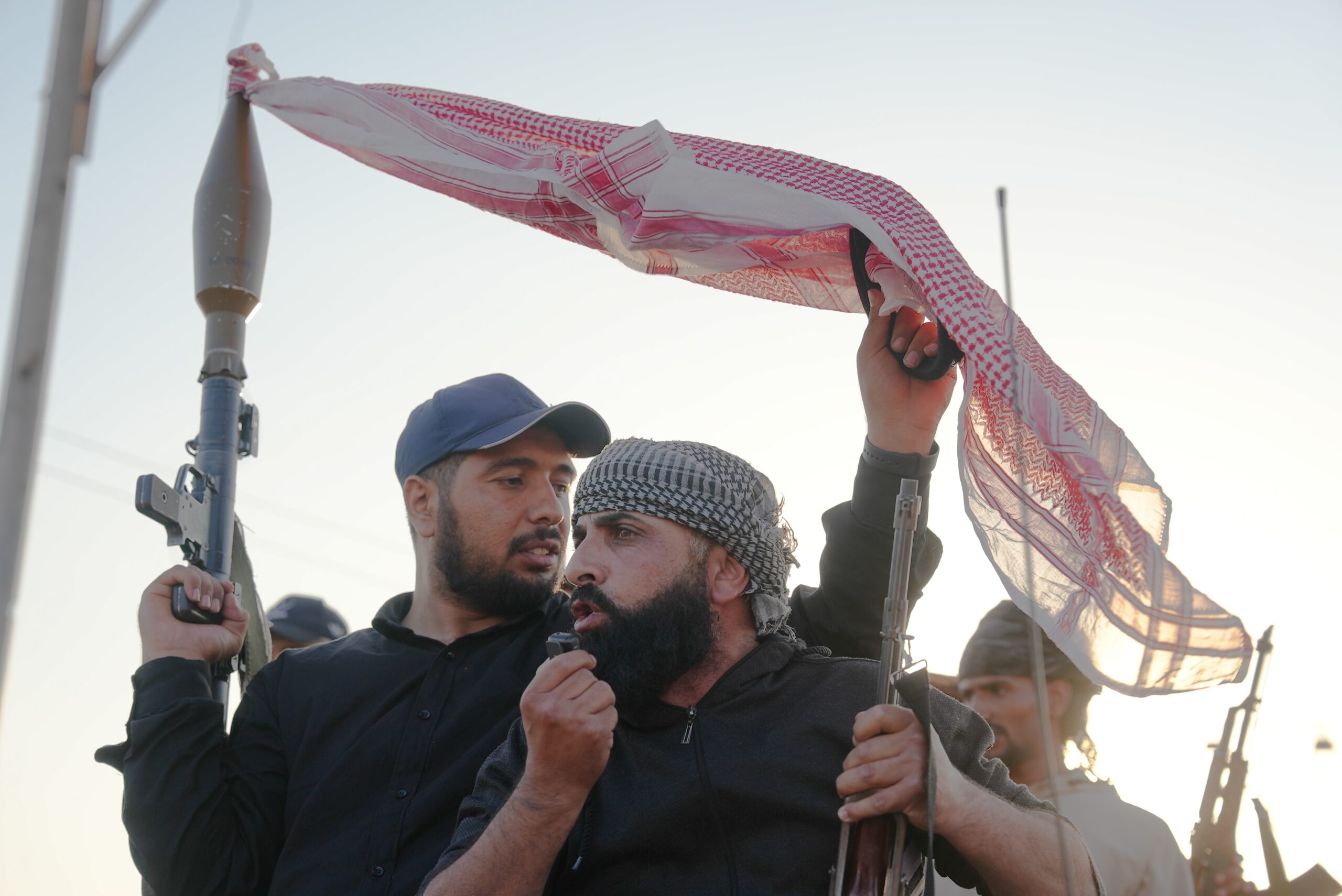
As political tensions mount between Damascus and DAANES, tribal leaders opposed to the SDF have stepped into the fray by announcing active mobilization. Several prominent sheikhs have declared a state of general mobilization, most notably Sheikh Faraj al-Hamoud al-Salama of the Al-Nasser tribe, representing the influential Boushaaban alliance. On 11 August, Al-Salama announced full tribal readiness to confront the SDF.
His call appears to be resonating with other tribal leaders. Tribes such as Al-Saab, Al-Boubna, and Al-Boujaber have stressed the importance of tribal unity and expressed a shared resolve to fight “until the enemy lays down their swords.” In the Turkish-controlled “Peace Spring” zone located in northeast Syria, several sub-clans of the Boushaaban have also declared mobilization, vowing to continue their campaign until their objectives are achieved.
Sporadic skirmishes – that have so far fallen short of full-scale confrontations – have already been reported in several areas. For example, on 13 August, the SDF closed the al-Nashwa road in Hasakah and carried out a wave of arrests after one of its patrols came under fire and eight of its members were reportedly captured by individuals believed to belong to the al-Baqara tribe. The following day, clashes broke out in the town of Gharanij in eastern Deir Ezzor between tribal fighters and the SDF.
Although recent mobilizations have drawn attention to tribal opposition to the SDF, it is crucial to recognize that Arab tribes in northeast Syria are far from homogeneous. The Syrian conflict has fractured tribal structures over the years, creating divisions both between and within tribes. For instance, parts of major tribes such as the Shammar, Ogeidat, and Jabour have long cooperated with the SDF, participating in local governance and military formations, and they have so far maintained their alliance.
Other factions within these same tribes, however, have expressed persistent grievances – citing marginalization, forced conscription, and limited political inclusion. These divides often reflect local power dynamics, historical loyalties, as well as shifting interests. For instance, some tribes and tribal leaders had maintained closer ties with the Assad regime, while others forged pragmatic alliances with the SDF. The current wave of mobilization, therefore, represents a significant but by no means uniform tribal position.
As tribal rhetoric hardens and Damascus distances itself from negotiations, the risk of open conflict in northeast Syria, including Raqqa, Deir Ezzor, Manbij, and Hassakeh, is growing – threatening to ignite a new and destabilizing front in an already fragile landscape.
Tribal-State Alliance
The strong relationship between tribal leaders and the transitional authorities in Damascus, along with a clear alignment of strategic objectives – particularly the goal of expanding government control in northeast Syria – can be seen as a key enabler of recent tribal mobilization against the SDF.
Since the collapse of the Assad regime, the transitional government has actively worked to cultivate ties with tribal leaders across Syria, including those in the northeast. From the outset, Damascus has positioned traditional authorities – especially tribal figures – as central actors in the political transition. They were extensively consulted during the various transitional processes, and included in the national dialogue, the drafting of the constitutional declaration, and the forming of the new legislative framework.
This sustained engagement has helped the transitional authorities gain both political legitimacy and localized support. The depth of these relationships has become increasingly visible, most notably in the large-scale mobilization of tribal forces during the clashes in Sweida. These instances underscore how effectively the government has embedded itself within key tribal networks across the country.
Crucially, the alignment between tribal leaders and the transitional authorities is not merely symbolic; it is strategic. Both share a common objective: removing the SDF from Arab-majority areas. For many tribal leaders, mobilizing against the SDF is a chance to reassert control over their local territories. At the same time, it serves Damascus’s broader ambition to reclaim authority over key regions currently beyond its reach. This convergence of interests creates fertile ground for tribal mobilization against a common adversary – whether or not it comes with an explicit green light from Damascus.
Echoes of Sweida
The mobilization of tribes – as a new military actor aligned with, yet distinct from, the government – carries troubling echoes of the clashes in Sweida. Although a ceasefire was brokered between Damascus and local factions in Sweida on July 17 after a brief period of fighting, thousands of tribal fighters from across Syria nonetheless marched into the governorate to confront Druze armed groups. In a widely circulated video, a spokesperson for the Syrian Tribal and Clan Council called on “all members of the tribes from east to west, from north to south” to head to Sweida immediately. According to various estimates, more than 50,000 tribal fighters reportedly took part in the offensive.
Now, in Deir Ezzor and Raqqa – two Arab-majority areas already brimming with frustration toward DAANES governance – a similar scenario may be taking shape. This escalation builds on years of deep-seated grievances. Tribal leaders have long accused the SDF of marginalizing Arab communities, enforcing compulsory conscription, and consolidating Kurdish political control. Today, those frustrations are being repackaged into a broader rallying cry: “liberating the Jazira under Syria’s umbrella.”
As in Sweida, if this mobilization materializes, it could attract not only tribal forces from across the country but also fighters from a range of factions – particularly Turkish-backed groups based in northwest Syria.
Opportunity in Chaos
When tribal forces mobilized against Sweida, Damascus largely remained on the sidelines, watching events unfold for nearly two days. The government only intervened under mounting international pressure. Even then, officials stopped short of condemning the indiscriminate and unsanctioned attacks carried out by tribal fighters against the Druze, despite the reported violations committed by some of them. Instead, they praised the tribes for their actions, further emboldening their sense of legitimacy.
By portraying tribal militias as protectors of a new, emerging state – as some officials have suggested – Damascus risks encouraging further mobilization rather than deterring it. If similar threats materialize in the northeast, a repeat of the Sweida playbook is not out of the question.
If a tribal offensive were to break out, Damascus might initially take a hands-off approach. It could then deploy forces into areas where fighting is concentrated – positioning itself as a buffer between tribal fighters and the SDF. While framed as a peacekeeping effort, such a move would also advance Damascus’s interests by allowing it to reestablish a foothold and expand its authority in territories currently beyond its control
For some within the government, the fighting could be seen as an opportunity: the wider the clashes, the more ground Damascus might be able to reclaim and hold. Additionally, the conflict could weaken the SDF’s negotiating position, particularly if political talks remain frozen. Deir Ezzor Governor Ghassan al-Sayed Ahmad has already hinted at a potential escalation, stating his readiness to deploy military divisions if negotiations fail.
At the same time, Turkey has intensified its criticism of the SDF, warning that its patience is running out over the group’s refusal to integrate under a unified command structure. Security sources have reportedly indicated that while a direct Turkish intervention is unlikely, Ankara could provide indirect support for a limited military operation. While such support was officially framed as backing the Syrian army, it is plausible that Ankara could authorize Turkish-backed Syrian factions to join the fighting if tribal forces initiate an offensive against the SDF.
In contrast, key international actors such as the United States and France would likely oppose any escalation, citing serious security risks posed by instability in northeast Syria, particularly regarding the fate of ISIS detainees and the broader implications for Syria’s political transition. However, aside from issuing calls for de-escalation, their ability to directly prevent tribal mobilization is limited. As demonstrated during the tribal assault on Sweida, both Washington and Paris ultimately had no choice but to rely on Damascus to intervene and halt the offensive.
A Risky Gamble
For the government, expanding its authority through tribal forces – especially amid stalled negotiations – may seem like an attractive option. However, this approach is dangerously short-sighted. The long-term consequences far outweigh any short-term political gains.
First, a tribal offensive, particularly one perceived as sanctioned or supported by Damascus, would almost certainly destroy any remaining prospects for dialogue with the DAANES. It would deepen Kurdish fears of betrayal, severely erode trust, and make future reconciliation efforts far more difficult – just as the events in Sweida demonstrated.
Second, such a campaign would further inflame already fragile ethnic relations between Arabs and Kurds. Many minority communities in Syria already view the central government with suspicion. A tribal-led assault, even if not officially endorsed by the state, would amplify these concerns and reinforce perceptions of state-sanctioned violence against minorities and their exclusion.
Third, the SDF’s military capabilities – estimated at 40,000 to 60,000 fighters, including 20,000 to 30,000 well-trained and highly motivated Kurdish troops – significantly surpass those of the Druze factions. This makes any tribal offensive in northeast Syria far less likely to be resolved quickly. Instead, it could lead to a protracted and destabilizing conflict. Sustained fighting in the northeast would likely unravel existing security arrangements, spark new waves of displacement, and provide a window of opportunity for extremist groups to regroup. ISIS remains active in desert regions and detention facilities, and escalating conflict would create more favorable conditions for its resurgence.
Fourth, ongoing instability would stifle economic recovery. Foreign investment and humanitarian aid – both critical to Syria’s reconstruction – would be driven away by violence, political uncertainty, and contested territorial control.
Finally, Turkish potential support adds another layer of complexity and danger. Ankara’s hostility toward the SDF and its support for certain tribal factions mean that any escalation could quickly take on a broader regional dimension, drawing in outside actors and further destabilizing the country.
On the Brink
The Syrian government now faces a defining test: it can either allow tribal mobilization to spiral into open conflict, or it can reassert leadership through de-escalation and inclusive dialogue. This requires a renewed commitment to addressing local grievances through negotiation, not force. The alternative is a slow-motion collapse that will spare no one from its devastating ripple effects.
The violence in Sweida erupted because warning signs were ignored. The government bears a significant share of responsibility – both for its actions and its failures to act. What matters now is not merely remembering what happened in Sweida, but learning from it. It must serve as a clear warning to prevent northeast Syria from becoming the next battleground.
The stakes could not be higher. Syria cannot afford another episode of civil war during its fragile transition. If the transitional government is serious about national unity, it must rise above short-term political calculations and choose the more difficult but essential path of inclusion.
In this moment of rising danger, Damascus’s silence in the face of tribal mobilization amounts to complicity. The government must act – urgently and decisively – before another front erupts and another chapter of suffering begins. True leadership now means showing not just strength, but vision, restraint, and the political maturity to prevent a war no one can win.